
Air bikes for intensive full-body training
An air bike combines cycling with an active pushing and pulling movement of the arms. Its fan provides progressive resistance: the harder you pedal and move the handles, the more demanding the workout becomes. Explore robust air bikes from Assault Fitness and Flow Fitness for intensive intervals, conditioning and commercial use.



What is an air bike?
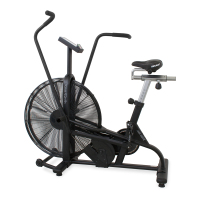
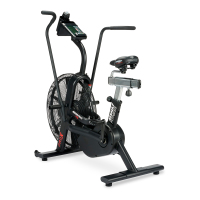
An air bike, also called a fan bike, is a fitness bike with a large fan wheel and moving handles. You drive the fan with your legs and arms, working your upper and lower body together. Air bikes are widely used for intensive cardio, warm-ups and short interval sessions.
How does air resistance work?
The rotating fan moves air and creates resistance. As you pedal faster and push and pull the handles harder, air resistance automatically increases. There is no need to select a resistance level first: the intensity responds directly to your effort.
Which muscles does an air bike work?
Pedalling mainly works your quadriceps, hamstrings, calves and glutes. The moving handles also engage your arms, shoulders, chest and back. Your core muscles help keep your body stable while your arms and legs apply force.
Why choose an air bike for interval training?
An air bike responds as you speed up or slow down, making it easy to alternate short, hard efforts with gentle recovery. This suits HIIT, circuit training and sessions based on time, distance, calories or intervals.
Air bikes are not just for maximum effort. At a steady pace, you can also use one for warming up, cooling down or longer conditioning sessions. You control the intensity through your effort.
Air bike or exercise bike?
On a conventional exercise bike, you mainly work your legs and usually adjust resistance manually or electronically. An air bike uses both pedals and moving handles, with resistance increasing automatically as your pace rises. It offers a responsive full-body workout, while a conventional exercise bike generally focuses on controlled, comfortable cycling.
Air bike or indoor cycling bike?
An indoor cycling bike recreates an athletic cycling position and usually uses adjustable friction or magnetic resistance. An air bike has a fan and actively involves your upper body too. An indoor cycling bike is often a better fit for cycling-specific training, while an air bike suits full-body intervals and functional conditioning.
What should you look for when buying an air bike?
Compare frame construction, maximum user weight, stability and saddle adjustment. Check whether the horizontal and vertical adjustment ranges suit your height and reach. Also consider the machine's dimensions and allow enough clearance for the moving handles.
The monitor matters too. Depending on the model, it displays time, distance, speed, power, cadence and estimated calorie expenditure. Preset work and rest periods or custom interval settings are particularly useful for interval training.
Air bikes for home and commercial use
You can use an air bike at home, but its fan and moving handles require more space than a compact exercise bike. The fan also produces clearly audible airflow during hard efforts. For gyms, personal training studios and functional training spaces, a sturdy frame, easy-to-maintain drivetrain and high load capacity are particularly valuable. Check the manufacturer's intended usage rating.
How do you compare fit and comfort?
Riding position, handle movement, air resistance and stability vary between air bikes. Compare saddle adjustments and handle reach with your height and preferred posture. Consider noise, available space, training goals and expected frequency of use. Specifications help you compare models but cannot fully describe how comfortable a particular bike will feel for you.
Air bikes are part of our complete range of cardio fitness equipment for training at home and in commercial fitness facilities.
