
Treadmills for home and commercial use
A treadmill lets you walk, jog or run whenever it suits you, whatever the weather. Our range includes compact and folding treadmills for home, sturdy models for intensive training and commercial treadmills for fitness facilities.


3199,-
2899,-

1450,-

750,-

599,-

599,-

699,-

850,-

899,-

999,-

999,-

1050,-

1150,-
1169,-

1250,-

1399,-
1439,-
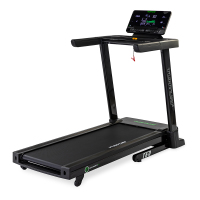
1599,-


1999,-

2299,-
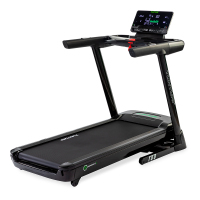
2499,-
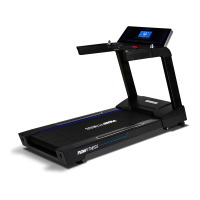
2999,-

3149,-

3299,-

4499,-

4838,-
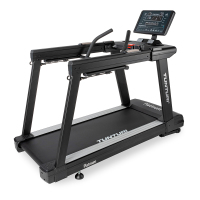
5299,-
Why train on a treadmill?
A treadmill helps you improve your fitness, endurance and running speed. You set the pace without having to worry about rain, cold, darkness or uneven ground. By varying the speed and incline, you can use a treadmill for walking, steady endurance workouts, interval training and intensive running sessions.
Which treadmill is right for you?
The right treadmill depends mainly on how you intend to use it and how often you train. For walking or gentle jogging, a more compact model with a moderate top speed will usually be sufficient. Regular or intensive runners benefit from a stable treadmill with a spacious running surface, a powerful motor and a higher maximum speed. For daily use by several people, a semi-commercial or commercial model is the best choice.
How large should the running surface be?
The running surface determines how much room you have to move while walking or running. A smaller surface may be sufficient for walking. When running, your stride gets longer, so a longer and wider running surface is more comfortable and safer. Taller users and those who train at higher speeds particularly benefit from extra space. Compare not only the treadmill's overall dimensions, but also the length and width of the actual running surface.
What speed and incline do you need?
A modest top speed is sufficient for walking, while joggers and runners need a model that can comfortably handle higher speeds. An adjustable incline makes your workout harder without requiring you to run faster. It simulates hilly terrain and adds variety to endurance and interval training. More advanced treadmills automatically adjust the speed and incline during a workout programme.
What should you look for when buying a treadmill?
When comparing treadmills, consider the running surface, maximum speed, incline options, stability and maximum user weight. Ideally, choose a model with a maximum user weight comfortably above your own body weight. This provides a useful safety margin and generally also indicates a sturdier frame.
Also consider the overall dimensions, deck height and clearance around the machine. Check the available ceiling height, as you stand higher than floor level when training, and using an incline can increase that height further.
Folding treadmills for home
A folding treadmill is practical if you cannot permanently dedicate space to the full machine at home. After your workout, you fold the running deck upwards to reduce its footprint. Bear in mind that foldable does not necessarily mean easy to move or stow away: many treadmills remain relatively large and heavy even when folded. Check both the dimensions in use and the folded dimensions before buying.
Workout programmes, heart rate monitoring and apps
Built-in workout programmes automatically alternate between different speeds and incline levels. Treadmills with heart rate control programmes can adjust the workout intensity based on your heart rate. Some models connect to a smartphone or tablet via Bluetooth, allowing you to use compatible training apps and track your workout data.
Motorised or self-powered treadmill?
On a motorised treadmill, a motor drives the belt and you select the desired speed. A self-powered treadmill has no drive motor: your own movement sets the belt in motion. Self-powered models respond directly as you speed up or slow down and are widely used for intensive interval training, sprints and functional training.
Treadmills for home and commercial use
Home treadmills are designed for one or a few users and are often foldable. Semi-commercial models are suitable for more intensive use, for example in personal training studios, workplace gyms and smaller training facilities. Commercial treadmills have a heavier frame and are built for prolonged daily use by many different people.
How do you compare the feel and comfort of a treadmill?
Specifications do not tell you everything about how a treadmill feels. When comparing models, consider the cushioning, frame stability, motor response, controls and noise levels. Check whether the running surface suits your height and stride, and whether the speed and incline options match your training goals. Also consider how often you plan to train and whether other people will use the machine.
This category is part of our complete range of cardio fitness equipment, which also includes elliptical trainers, exercise bikes, rowing machines and indoor cycling bikes for home and commercial use.
